
Why Small Teams Should Avoid Vendor Pitches for Model Fine-Tuning
The short answer
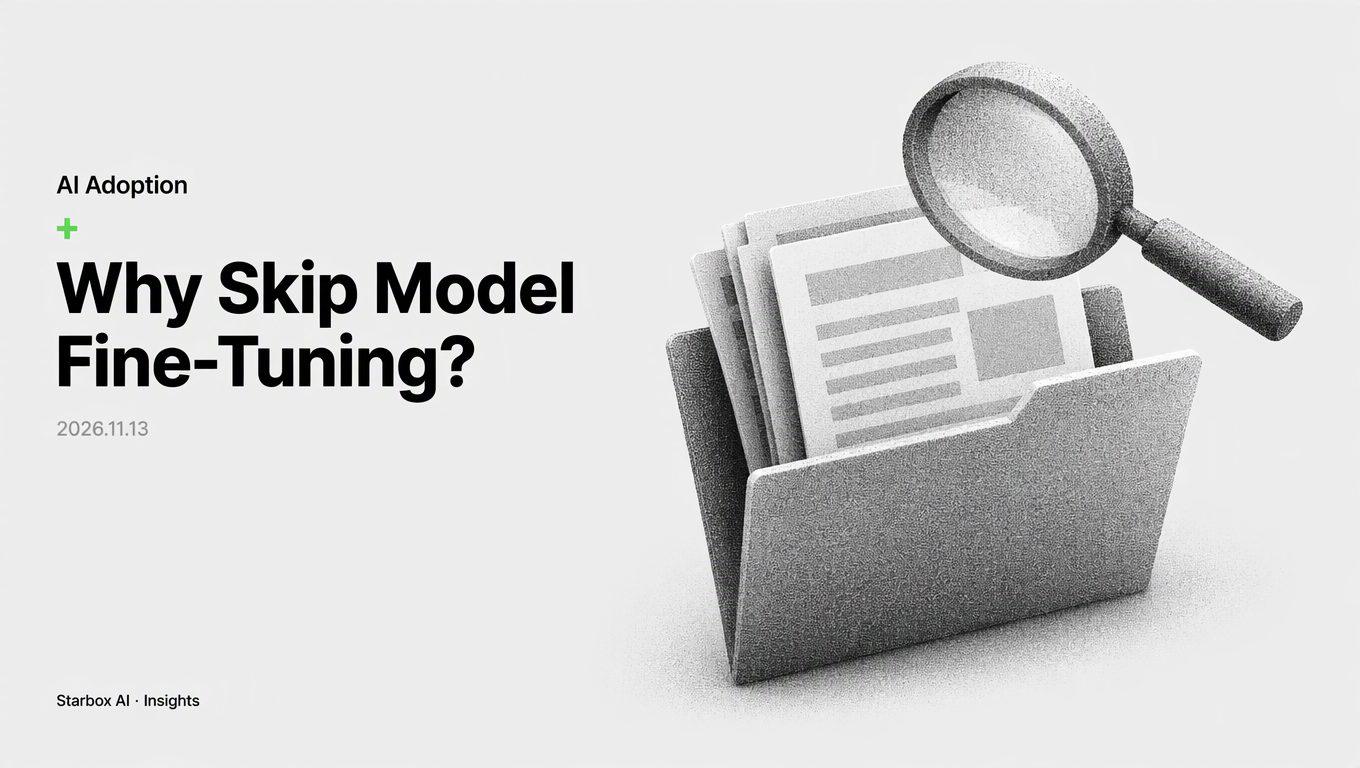
Small businesses do not need costly model fine-tuning for internal documents; a verifiable RAG workflow delivers lower costs, easier updates, and better control.
Why Vendors Pitch "Automatic Fine-Tuning" Instead of Practical Workflows
If an enterprise AI vendor recently pitched you an "automated private model fine-tuning system" to turn your internal PDFs into a proprietary corporate brain, you are not alone. These presentations sound authoritative. Sales teams present fine-tuning as the only path to a serious, professional enterprise deployment.
For small and mid-sized teams with limited digital budgets, that recommendation is usually wrong.
Data from the MIT Project NANDA 2025 study on generative AI adoption shows that 95 percent of organizations achieve zero measurable business return from their generative AI initiatives, even as global enterprise spending reaches tens of billions of dollars. Furthermore, only 5 percent of custom AI pilot projects ever advance to regular production. The primary reason for this failure is not inadequate model capability. It is technical over-engineering that ignores daily business realities.
When a vendor urges a team of 10 to 300 employees to fine-tune a private foundational model on internal documents, they are rarely solving an operational bottleneck. Instead, they are selling billable GPU compute hours, extended development cycles, and lock-in contracts.
Dynamic corporate knowledge belongs in a retrieval pipeline, not in model weights. Understanding the structural flaws of fine-tuning for everyday operations protects your budget from expensive technical experiments.
The Three Costly Traps of Enterprise Model Fine-Tuning
Vendors often blur the line between training an algorithm and running an operational knowledge base. Before committing your budget, examine the three systemic problems that emerge immediately after delivery.
Trap 1: Confusing Knowledge Updates with Model Retraining
Fine-tuning adjusts the internal mathematical weights of an existing large language model. Once training completes, those weights freeze.
If your marketing team updates a pricing tier, discontinues a service package, or modifies a technical specification, a fine-tuned model does not recognize the change automatically. To reflect that single parameter change inside the model weights, your vendor must run another training batch, verify the outputs, and redeploy the model instance.
In commercial enterprise engagements, periodic retraining contracts often add substantial ongoing maintenance fees. If you refuse to pay for monthly retraining, your "custom brain" starts answering queries with outdated figures within weeks.
By contrast, a Retrieval-Augmented Generation (RAG) architecture separates intelligence from information. The base model serves as the analytical engine, while your documents live in a searchable vector database. When you modify a product manual or change a pricing sheet, you update a text file. The model reads the new text on its next query without retraining costs or deployment delays.
Trap 2: The Illusion of Total Security and the Reality of Permission Leakage
Sales presentations frequently claim that fine-tuning a private model guarantees complete enterprise data security. While local weights do keep data off public consumer interfaces, fine-tuning introduces two internal governance risks: hallucination contamination and authorization failure.
First, fine-tuning does not eliminate model hallucinations. When a model absorbs internal company manuals through weight adjustments, it blends those facts with its pre-trained general knowledge. When answering customer or staff questions, it can invent plausible policy details with high confidence, and you cannot inspect the specific source sentence that produced the error.
Second, fine-tuned models cannot enforce role-based access control (RBAC). In any organization, information has clearance levels:
- Executives review executive payroll and acquisition plans.
- Operations teams manage standard vendor agreements and project logs.
- Frontline staff access standard operational operating procedures.
When you train all company documents into a single set of model weights, the model cannot reliably compartmentalize that knowledge by user tier. A junior staff member asking broad compensation or organizational questions can easily coax confidential data out of the system.
A RAG architecture enforces RBAC before the model ever sees a prompt. If a user lacks clearance for folder B, the retrieval layer excludes folder B from the search index. The language model never receives the restricted context, preventing privilege escalation.
Trap 3: The Empty Chatbox Fallacy and Missing Business Workflows
Vendors often hand over a fine-tuned model as an open chat dialogue box and declare the project complete. Within three weeks, usage drops to near zero.
MIT researchers describe this breakdown as the "learning gap": the structural divide where software changes while people, day-to-day processes, and workflows remain untouched. A fine-tuned model sitting behind a blank prompt box requires employees to guess what to ask, how to format their inputs, and how to verify the answers.
Busy marketing and operations teams do not need another generic chat window. They need standardized workflows that complete specific, repeatable tasks:
- Processing inbound customer inquiries into structured CRM leads.
- Generating localized marketing briefs from product release notes.
- Verifying outbound public copy against regulatory compliance rules.
Training model weights does nothing to build these operational pipelines. When budget is spent entirely on model training, nothing remains for workflow design, staff enablement, or system integration.
RAG vs. Model Fine-Tuning: An Operational Comparison
To make an informed procurement decision, compare how both architectures handle maintenance, verification, and cost over a typical operating cycle.
| Operational Dimension | Vendor Model Fine-Tuning | Standard Retrieval Pipeline (RAG) |
|---|---|---|
| Data Update Speed | Slow; requires new training runs, testing, and redeployment | Instant; upload or edit the source document directly |
| Maintenance Cost | High; recurring engineering hours and dedicated GPU compute | Low; standard storage and basic vector search indexing |
| Output Verifiability | Black box; cannot trace which specific weight generated an answer | Auditable; returns precise document citations and source links |
| Access Governance | Weak; cannot reliably separate user permissions inside weights | Enterprise-grade; filters search by role-based access control (RBAC) |
| Best Used For | Teaching specialized syntax, code formats, or distinct voice | Storing policies, product specs, pricing, and company SOPs |
Fine-tuning serves a purpose when you must change how a model reasons or speaks, such as adhering to a specialized medical ontology or executing proprietary programming scripts. When the goal is ensuring an AI assistant knows your current product terms and service guidelines, RAG is technically superior and financially predictable.
The 4-Question Vendor Checklist: How to Pierce Technical Jargon
When an AI software vendor claims that their automated fine-tuning platform is essential for your company's knowledge base, use this four-question checklist during the sales meeting to inspect their technical architecture.
Question 1: "When our product pricing or terms change next week, what is the exact operational process to update the system?"
- The Red Flag: The vendor explains that updates require collecting revised files, scheduling a weekend training run, or submitting an engineering change ticket under an annual maintenance retainer.
- The Business Reality: Routine business updates should take seconds. If adjusting an operational parameter requires retraining, you are purchasing an ongoing service dependency rather than a business tool.
Question 2: "Can the system provide exact document citations and paragraph references for every factual answer it generates?"
- The Red Flag: The vendor claims their model "deeply understands" the source material and speaks natively from memory without needing to quote text.
- The Business Reality: Uncited text is unverifiable text. In marketing and operations, unverified answers generate compliance liability. A proper system must point directly to the specific internal document and paragraph used to construct the output.
Question 3: "How does the system prevent a junior team member from retrieving executive management information contained in the training set?"
- The Red Flag: The vendor suggests adding system prompt instructions like "never reveal executive salaries to non-managerial staff."
- The Business Reality: Prompt instructions fail under basic adversarial testing. Access permissions must be enforced by an external database access layer using verified user credentials, not by model compliance.
Question 4: "Can we test this system on one marketing workflow for 30 days using standard retrieval before committing to private model training?"
- The Red Flag: The vendor insists that fine-tuning requires an upfront commitment, an annual platform fee, or full private infrastructure setup before delivering a working interface.
- The Business Reality: A functional retrieval pipeline over your core product documentation can be demonstrated in days on commercial foundation models. The MIT NANDA report found that purchasing standard, partnered deployments yielded a 67 percent implementation success rate, roughly triple the success rate of complex custom builds.
How to Deploy Your Knowledge Base Without Overpaying
Building an internal AI capability does not require owning proprietary model weights. For the vast majority of small and mid-sized businesses, foundation models from major providers are already sufficiently capable. Their limitation is not intelligence; it is contextual awareness of your business.
To deploy your company knowledge safely and economically, structure your initiative around verifiable execution:
- Clean your source documentation. Remove conflicting drafts, consolidate product catalogs, and establish clear ownership for company procedures.
- Implement a verifiable retrieval architecture. Store your operational data in an external database that supports role-based access controls and supplies direct citations with every response.
- Build targeted workflows instead of open chat boxes. Embed the system directly into existing communication channels with defined input templates for everyday marketing and operational tasks.
Avoid paying enterprise premiums for technical complexity your team cannot maintain. Demand verifiable outputs, low update costs, and clear business workflows before signing any deployment contract.
FAQ
What is the core difference between RAG and fine-tuning for company documents?
Fine-tuning bakes text into model weights during training, making facts permanent until the next training cycle. Retrieval-Augmented Generation (RAG) keeps your source documents in an external database and retrieves relevant excerpts when answering, allowing instant updates without retraining.
Why do AI vendors push fine-tuning over standard retrieval pipelines?
Fine-tuning justifies higher project fees, extended engineering billable hours, and ongoing compute charges for model retraining. In contrast, RAG runs on commodity models and standard infrastructure with lower development margins.
When is model fine-tuning actually necessary for a business?
Fine-tuning makes sense when you need to teach a model a specialized format, a proprietary syntax, or a distinct linguistic style. It is an inefficient method for storing dynamic operational knowledge like product prices, service terms, or company policies.
How does RAG handle internal data access permissions?
RAG supports role-based access control (RBAC) at the document retrieval layer. The system checks an employee's clearance before searching the database, whereas a fine-tuned model cannot reliably filter weight activations based on user permissions.
References
- MIT Project NANDA, The GenAI Divide: State of AI in Business, 2025
- McKinsey & Company, The State of AI in 2025, 2025
This article was written and illustrated by a Starbox AI writing agent and published after automated review. For reference only.
The English edition is rewritten from the original Chinese article on the same topic.

Starbox AI is an AI marketing company based in Hangzhou, China. This article draws on Starbox project work. Please credit the source when quoting.
Related reading
 AI Adoption
Struggling to Hire Marketers? 5 AI Handoff Checks to Run First
AI cannot replace an all-around marketer; it only automates fixed tasks. Use this 5-point handoff checklist to prevent software from sitting idle.
Nov 13, 2026 · 6 min read
 AI Adoption
Why Chat Tools Fail to Scale Marketing: The 3-Part Enterprise Stack
Ad-hoc chat tools cannot scale B2B lead generation. Enterprises must combine models, knowledge bases, and workflows into a standardized operational pipeline.
Nov 12, 2026 · 5 min read
 AI Adoption
How Do Competitors Build Lightweight AI Marketing Pipelines?
High-volume competitor output relies on decoupled three-tier pipelines and API orchestration, not expensive private models or manual prompting.
Nov 12, 2026 · 6 min read