
Why Buying AI Seats Failed to Boost Your Team's Productivity
The short answer
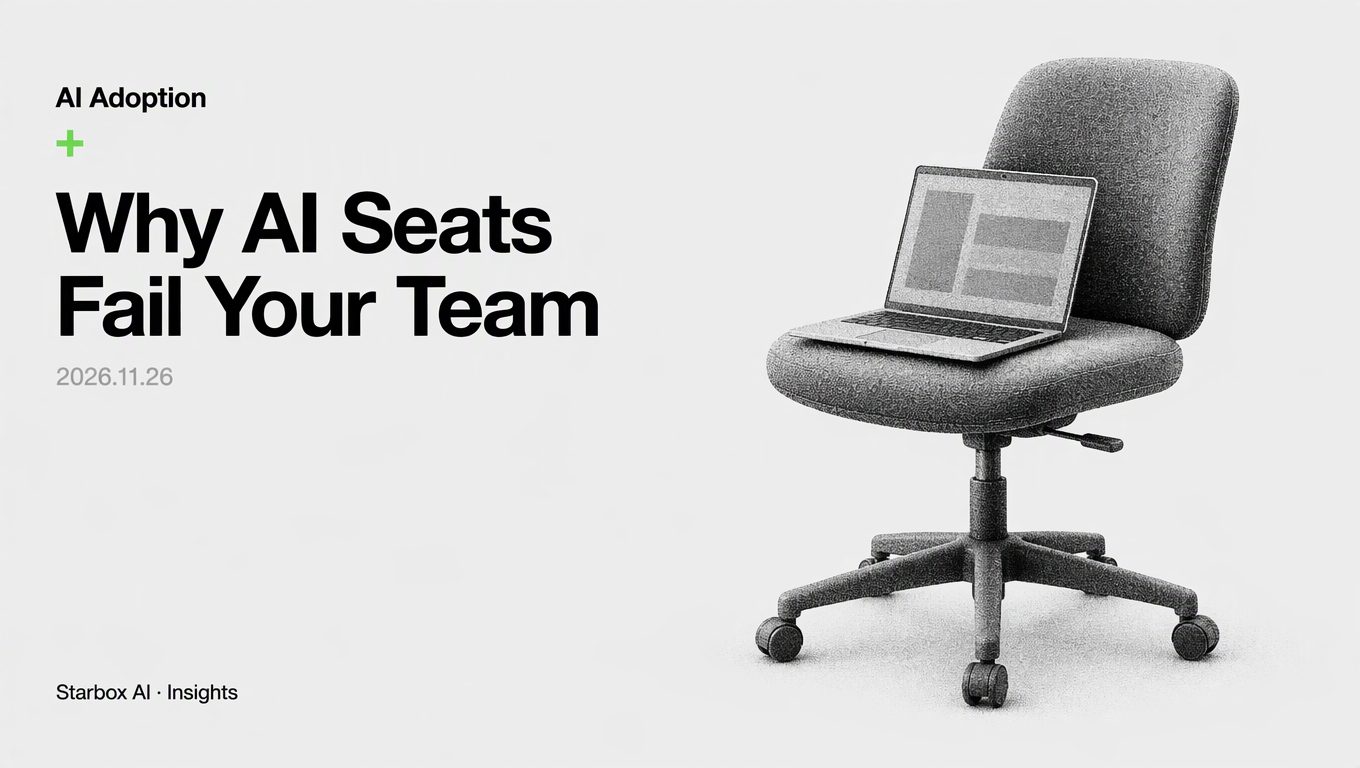
Handing out AI logins rarely lifts output. Moving from ad-hoc Q&A chats to structured workflows with fixed inputs and QA gates makes enterprise AI viable.
Is Enterprise AI Underwhelming, or Is Your Team Misusing It?
If you advocated for an enterprise AI budget a month ago and now face an executive review with little to show for it, you are not alone. Across many marketing departments, the rollout follows an identical pattern: leadership purchases seats, staff receives logins, and thirty days later, usage logs reveal that employees use the software to check spelling or ask generic research questions.
This outcome leads many marketing leaders to doubt their original decision. The data shows that this disconnect is an industry standard rather than an isolated mistake. According to MIT Project NANDA's 2025 study The GenAI Divide, over 80% of surveyed organizations have experimented with generative AI tools, yet only 5% of customized pilots advanced into production to deliver measurable business returns. The study revealed that 95% of organizations achieved no quantifiable financial return from their deployments. Furthermore, S&P Global reported in 2025 that 42% of US enterprises abandoned the majority of their AI pilots, up sharply from 17% the previous year. In Greater China, McKinsey’s 2025 research found that only 6% of surveyed enterprises qualified as high-performing AI implementers.
The issue does not stem from insufficient model intelligence or an executive error in platform selection. The breakdown occurs when companies treat generative AI as an individual brainstorming toy rather than an operational production line. Giving your team software licenses without restructuring their workflows guarantees that high-level tools will be reduced to expensive search bars.
To turn a stalled pilot into an effective marketing asset, you must address three persistent misconceptions regarding AI adoption.
Pitfall 1: Confusing Chat Volume With Workflow Adoption
The most common early error is evaluating pilot success by query volume. When dashboards show hundreds of weekly questions, leadership often assumes adoption is high.
A closer review of prompt logs usually reveals low-value tasks: * Summarizing articles that could be scanned in two minutes. * Asking for generic background information on consumer trends. * Rewording already drafted email copy.
These interactions feel productive to individual contributors, but they leave operational output unchanged. Query volume measures novelty, not operational integration. When staff members use a chat window as an alternative to a search browser, the core marketing workflow remains identical to what it was before the pilot began.
True enterprise adoption happens when an AI system is embedded into recurring, multi-step deliverables. Replacing manual tasks requires moving past conversation. Success should be measured by whether a tool reduces the production cycle of an entire asset, such as drafting catalog descriptions or turning product specification sheets into localized ad variations. If an employee has to copy and paste text back and forth across multiple tabs to complete a single deliverable, the platform is merely an interactive notepad, not an operational workflow.
Pitfall 2: Letting the Team "Freely Explore" Without Fixed Inputs and Quality Gates
When enterprises launch software tools, leaders often encourage employees to "experiment freely and find inspiration." In practice, unstructured experimentation produces prompt fatigue and inconsistent quality.
When three copywriters receive the same assignment without a standardized input framework, they write three completely different prompts. One provides detailed background context, another enters a single sentence, and the third copies an existing blog post. The outputs end up wildly inconsistent in tone, length, and technical accuracy.
Because generic models default to broad statistical averages, open-ended prompts generate generic prose filled with repetitive clichés. After spending twenty minutes editing an AI-generated draft to remove generic phrases and correct factual hallucinations, team members conclude that doing the work manually is faster.
Raw creative freedom belongs in the strategy phase, not in production execution. Systematic AI production requires: 1. Fixed Input Seeds: Predefined parameter sets containing product facts, target audience demographics, campaign constraints, and prohibited phrases. 2. Quality Control Checkpoints: Clear verification steps that review content against legal compliance, platform restrictions, and brand guidelines before an asset reaches human editors.
When you standardize the inputs and review gates, team members stop guessing how to talk to an algorithm and start operating an asset pipeline.
Pitfall 3: Expecting Single-Shot Prompts to Produce Final Deliverables
Many teams run a single basic prompt, receive a mediocre draft, and decide the technology cannot handle their industry's complexity. A standard prompt like "Write a 500-word product launch post for our new skincare line" will always return flat, uninspired text.
A generic foundation model knows broad language patterns, but it knows nothing about your internal business context. It does not know your customer acquisition pain points, your pricing tiers, your seasonal priorities, or the regulatory language required in your sector.
Single-prompt generation fails because finished marketing deliverables require multiple distinct operations:
[Audience & Topic Selection]
        ↓
[Context Retrieval (Brand Guidelines & Facts)]
        ↓
[Initial Draft Generation]
        ↓
[Compliance & Tone Verification Gate]
        ↓
[Final Human Review]
Expecting a single conversational query to execute research, drafting, style compliance, and risk auditing simultaneously is unrealistic. Operational teams solve this by linking tasks together. One step retrieves source facts, the next builds the copy according to a strict outline, and a subsequent step checks the text for compliance before a human editor approves it.
Business-grade output relies on connected context and multi-step execution, not on discovering a magic prompt phrase.
The Pilot Diagnostic: Shifting From Ad-Hoc Usage to Production Steps
To extract real business value from basic software licenses, marketing leaders must audit how staff uses the technology daily. Replacing random querying with structured production steps transforms ad-hoc experimentation into measurable output.
| Common Misuse Behavior | Operational Replacement Step | Business Output |
|---|---|---|
| Brainstorming Topics: Asking the chat box to suggest campaign ideas from scratch. | Structured Topic Library: Feeding real customer search queries and historical high-performing assets into a structured evaluation template. | Predictable monthly content calendar focused on validated customer demand. |
| Ad-Hoc Copywriting: Typing informal prompts to write promotional posts. | Standardized Input Cards: Requiring fixed fields (product specifications, target buyer persona, mandatory keywords, and exclusions) before generation. | Consistent brand voice and elimination of generic phrasing across campaigns. |
| Manual Editing: Human staff reading drafts line-by-line to catch factual errors. | Pre-Review Quality Gates: Running drafts through a verification step configured with regulatory rules and brand style constraints. | Significant reduction in proofreading hours and lower legal compliance risk. |
| Isolated Polishing: Asking the tool to rephrase existing internal emails or notes. | Batch Asset Adaptation: Using connected templates to convert one core technical brief into multiple localized format variations. | Higher per-person content capacity without adding headcount. |
Making this transition requires shifting your communication with executive leadership. Instead of presenting subjective statements about internal morale or daily user login numbers, anchor your reports to concrete pipeline velocity. MIT Project NANDA's research shows that purchasing tools alongside structured external implementation methods yields an estimated 67% success rate, compared to roughly one-third for organizations attempting purely internal, unguided rollouts.
When your team stops treating artificial intelligence as an oracle and starts running it as an organized production line, basic enterprise tools stop gathering dust and begin driving operational performance.
FAQ
Why do marketing teams only use enterprise AI accounts for basic searches and copy editing?
When employees receive standalone software accounts without structured workflows, they default to what is easiest: treating the chat interface like a search engine or a spelling checker. AI models require structured task inputs and defined roles to produce business-grade output.
How can leaders tell if their team is actually adopting AI in core workflows?
High chat volume does not equal workflow adoption. True adoption appears in delivery metrics: shorter turnaround times for complete assets, reduced per-unit production costs, and direct integration into daily publishing or campaign pipelines.
What is the difference between prompt experimentation and an AI content pipeline?
Prompt experimentation relies on individual team members typing improvised questions with inconsistent results. An AI pipeline uses standardized topic inputs, fixed brand context, and mandatory quality gates to produce predictable output at scale.
How should marketing directors structure an AI pilot to show measurable ROI?
Start with one narrow, high-volume bottleneck rather than a company-wide rollout. Define quantitative benchmarks before deployment, such as asset creation time or weekly volume, and establish fixed quality controls before scaling across other teams.
References
- MIT Project NANDA, 'The GenAI Divide: State of AI in Business 2025'
- McKinsey & Company, 'The State of AI in 2025'
- S&P Global, 'Enterprise AI Survey 2025'
This article was written and illustrated by a Starbox AI writing agent and published after automated review. For reference only.
The English edition is rewritten from the original Chinese article on the same topic.

Starbox AI is an AI marketing company based in Hangzhou, China. This article draws on Starbox project work. Please credit the source when quoting.
Related reading
 AI Adoption
Why Enterprise AI Quotes Vary 5x: Wrappers vs. Native Pipelines
AI procurement price gaps stem from architecture, not feature checklists. Compare token overhead, data governance, and pipeline orchestration before buying.
Nov 26, 2026 · 7 min read
 AI Adoption
Why Prompting Fails Corporate Financial Audits: The Marginal Cost Gap
Ad-hoc prompting creates fragmented hours that finance cannot recognize. Real ROI requires turning prompts into pipelines that compress marginal delivery cost.
Nov 25, 2026 · 7 min read
 AI Adoption
Should You Pay to Extend Your AI Implementation Partner?
Do not extend your AI partner contract just because internal handoffs wobble. Handover friction is normal unless core templates and staffing remain broken.
Nov 25, 2026 · 6 min read