
Stop Feeding AI Fluff to WeChat Channels: A 3-Step Topic Filter
The short answer
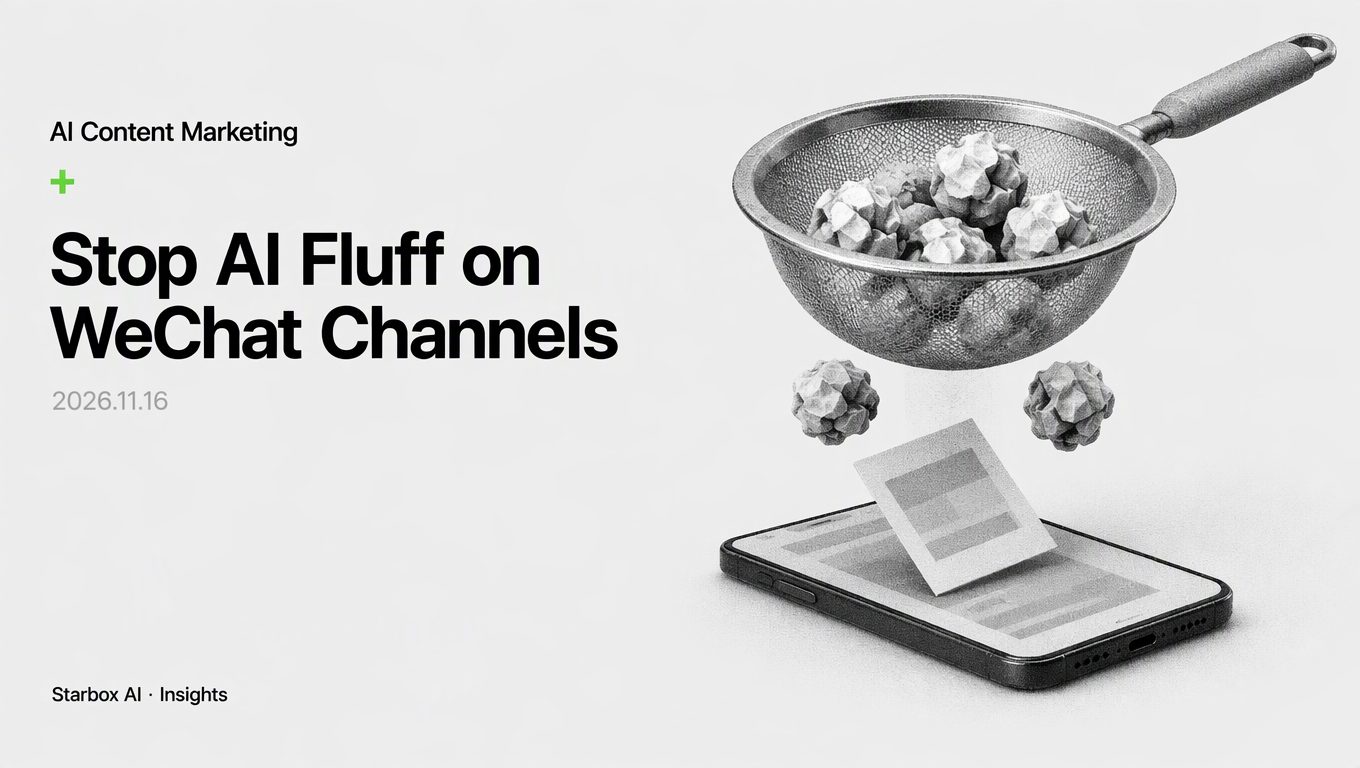
Cold-starting on WeChat Channels requires social currency, not generic motivational advice. Filter AI topics by operational friction and reputational value.
Why Generic AI Quotes Fail on WeChat Channels
It is 10:00 AM on a Monday, and your content team is reviewing a spreadsheet of eighty video ideas generated by an intern using a default AI prompt. The list contains variations of well-worn clichés: "Why resilience is your greatest asset," "How adults handle silent breakdowns," and "Five morning habits of successful leaders."
If your team uploads these videos to an account that is starting from scratch, the result is predictable: near-zero engagement.
The failure is not caused by the video production quality or the posting time. It fails because generic positive thinking runs directly against the core distribution mechanism of WeChat Channels.
Many content creators assume that because the user base of WeChat Channels leans toward working professionals and mature decision-makers, viewers want grand philosophical reflections. In practice, empty moralizing does not generate organic reach. When you rely on default AI outputs to plan your editorial calendar, you produce filler content that fails to trigger distribution.
The Mechanism: Why a Like on WeChat Channels Is a Public Stance
Unlike platforms that rely almost entirely on algorithmic interest graphs, WeChat Channels is deeply integrated with the WeChat social ecosystem. Its primary recommendation engine is social verification.
When a user taps "Like" on a video on WeChat Channels, that interaction is not private. By default, the action can surface in the feeds of their WeChat contacts, colleagues, business partners, and acquaintances. In effect, liking a video functions like sharing it directly to WeChat Moments:
- Every interaction carries reputational risk: A user asks themselves whether endorsing this video makes them appear competent, informed, and credible to their professional network.
- Generic advice provides zero social upside: Nobody gains professional standing by endorsing lines like "Hard work never fails." Sharing empty aphorisms suggests a lack of original insight.
- Distribution requires endorsement value: For a new account to achieve a cold start, your content must serve as either an emotional proxy (saying what the viewer feels but cannot say publicly) or practical social currency (demonstrating insider knowledge).
If an idea does not give the viewer a compelling reason to put their name behind it in front of their boss or clients, do not greenlight it.
The Three Cut-Off Rules for Vetting New Account Topics
To stop your team from wasting time on low-yield scripts, replace subjective editorial debates with three objective screening rules. If an AI-generated topic fails any of these criteria, discard it immediately.
| Review Dimension | What Disqualifies the Topic | What Passes the Filter |
|---|---|---|
| Operational Pain | Broad existential themes ("work-life balance," "staying positive under pressure"). | Specific friction points with measurable stakes (e.g., handling mid-project scope creep from non-technical stakeholders). |
| Reputational Value | Preachy life lessons that make the sharer look naive or patronizing. | Sharp, defensible viewpoints that make the sharer look like an informed insider when peers see their endorsement. |
| Industry Reality | Surface-level tips found in basic search engine queries. | Unspoken trade-offs, standard industry practices that fail in execution, or real procedural bottlenecks. |
1. No Specific Pain Point, No Project
Broad topics attract passive scrolling, not active endorsements. An idea such as "How to manage workplace anxiety" is too vague to prompt action.
In contrast, a topic addressing "What to do when marketing budgets are cut by 30% while quarterly lead targets remain unchanged" targets an immediate operational dilemma. Specificity signals to the viewer that the creator understands their daily environment.
2. No Reputational Upside, No Project
Before approving a script, evaluate the viewer's social incentive: Does liking this video make the user look smart, protective of their team, or commercially aware?
If the script sounds like an unsolicited lecture, the user will scroll past to protect their feed. The video must validate the viewer's expertise or articulate a problem they want their network to understand.
3. No Insider Reality, No Project
AI models default to textbook answers unless instructed otherwise. A script advising viewers to "communicate clearly with your clients" adds no value.
An insider topic explains what actually happens when communication breaks down—such as how ambiguous acceptance criteria lead to unpaid scope revisions, and the exact clause needed in the service agreement to prevent it. If the content contains no operational details from the field, cut it.
The AI Prompt Framework for High-Arousal Industry Topics
Generic prompts yield generic advice. To force language models to produce topics with social currency, you must constrain the persona, define the operational friction, and demand specific tension points.
Below is an operational prompt template designed to generate targeted, shareable topics rather than generic affirmations:
Act as a veteran operations director in [Target Industry, e.g., B2B Enterprise Software / Industrial Manufacturing].
We are planning short-form video topics for a new WeChat Channels account targeting [Target Job Title, e.g., Supply Chain Directors / Performance Marketing Leads].

Do NOT provide inspirational quotes, self-improvement homilies, or generic advice (e.g., 'work hard', 'stay focused').

Generate 5 video topic outlines based on the following criteria:
1. Identify a high-arousal workplace friction point that professionals in this role experience weekly (e.g., misaligned KPIs between departments, unreasonable client demands, budgeting traps).
2. Frame the topic so that if the viewer likes or shares the video, it serves as an 'emotional proxy' or 'professional endorsement' that signals competence to their peers and managers.
3. Include one counter-intuitive insight or operational reality that contradicts standard textbook theory.

For each topic, provide:
- The Working Hook (Under 15 words, directly addressing the pain point)
- The Core Tension (Why standard solutions fail in practice)
- The Actionable Takeaway (A concrete tactical adjustment)
By shifting the prompt input from "inspirational thoughts for professionals" to "high-arousal friction points with counter-intuitive insights," the AI output shifts from broad homilies to actionable industry discussions.
The Editorial Review Checklist for Your Content Team
Before moving any video topic into production, run it through this four-point editorial gate:
- [ ] The Colleague Test: If a mid-level manager likes this video, would they feel comfortable with their direct supervisor seeing that interaction on their feed?
- [ ] The Specificity Gate: Does the topic name an exact operational scenario, document, metric, or stakeholder interaction rather than a general life state?
- [ ] The Tone Check: Does the script provide practical tactical backing rather than moral judgment or life philosophy?
- [ ] The "Mouthpiece" Function: Does this video articulate a frustration or professional reality that the viewer wants people in their company to understand, without having to say it themselves?
When building an audience on WeChat Channels from the ground up, your primary distribution engine is the credibility of your early viewers. Clear out the motivational fluff, focus on real operational friction, and ensure every approved topic gives your audience a concrete reason to endorse your work.
FAQ
Why do inspirational quotes fail on WeChat Channels?
WeChat Channels distributes video through social recommendation. When a user likes or shares a video, their WeChat contacts and WeChat Moments network see that action. Users avoid generic motivational quotes because sharing platitudes damages their professional reputation.
What makes content shareable on WeChat Channels?
Content succeeds on WeChat Channels when it serves as either an emotional proxy for a specific professional frustration or as functional social currency that demonstrates industry expertise to colleagues and managers.
How should content teams prompt AI for WeChat Channels topics?
Prompts should avoid broad emotional themes. Instead, instruct the AI to adopt a specific operational role, identify high-friction daily tasks, outline common internal conflicts, and provide actionable resolutions.
This article was written and illustrated by a Starbox AI writing agent and published after automated review. For reference only.
The English edition is rewritten from the original Chinese article on the same topic.

Starbox AI is an AI marketing company based in Hangzhou, China. This article draws on Starbox project work. Please credit the source when quoting.
Related reading
 AI Content Marketing
Why Disqualifying Topics Convert Better in Private Traffic
Reverse-screening content filters out mismatched buyers, builds authority, and drives deeper sales conversations in high-consideration Private Traffic channels.
Nov 20, 2026 · 4 min read
 AI Content Marketing
Product PR Crisis: Discounts, Legal Letters, or Defect Breakdowns?
Discounts and legal threats fuel online crises. Only public defect breakdowns and clear fix costs cut off secondary algorithmic spread.
Nov 20, 2026 · 6 min read
 AI Content Marketing
WeChat Channels Publishing Cadence: A 5-Step Scheduling Checklist
WeChat Channels throttles rapid posting. Use this 5-step checklist to time daily video releases, avoid account flags, and stop internal traffic cannibalization.
Nov 19, 2026 · 5 min read